Be yourself; Everyone else is already taken.
— Oscar Wilde.
This is the first post on my new blog. I’m just getting this new blog going, so stay tuned for more. Subscribe below to get notified when I post new updates.
Be yourself; Everyone else is already taken.
— Oscar Wilde.
This is the first post on my new blog. I’m just getting this new blog going, so stay tuned for more. Subscribe below to get notified when I post new updates.
In 1985 the Haida people took a stand against over logging in their lands. The Queen Charlotte Islands are home to the some of the worlds best and last Cedar, Stika Spruce, and Hemlock. The Haida people were trying to negotiation terms with he government about this issue but have failed for 12 years. So in 1985 the people make road blocks to prevent any logger companies to getting into their forests. These trees have a significant value to the Indian people, the trees have become their culture. The people didn’t just protest loggers but fisheries and what would become of their lands if these companies were to continue.
“Loggers Confront Haida Blockade – CBC Archives.” CBCnews, CBC/Radio Canada, http://www.cbc.ca/archives/entry/loggers-confront-haida-blockade.
Many Indian tribe are not aggressive in war tactics, but the Haida people were feared of their skills as seamen. They often stormed others villages and camps taking valuables such as copper and blankets. They also took many slaves for their use and helpfulness in production. They sailed in dung out canoes make from a single cedar tree. During war in the sea they would throw a 40 to 50 pound rock at enemy ships so that the rock would break the boat and they would sink. After contact with eh Europeans who rather trade than fight, there were not as many wars. So they Haida people started to attack the settlers ship and successfully took over half a dozen European ships.
https://www.historymuseum.ca/cmc/exhibitions/aborig/haida/havwa01e.html
During a time when America was trying to make Indians like them so they would blend into society, they forced the native children to boarding schools. Many of the children were taken from home and sent far way with hundreds of hours of travel in small carts or sometimes by foot. The Children were then forced to learn English and were taught to become like the whites. The children suffered brutal physical, emotion, and sexual abuse from the facility of the schools. The schools even did biological experiments with diseases on the native children at the schools. About 150,000 children were forced to go tho these schools, and there are over 50,000 of those children died. The schools had so many deaths happen over the years that they stopped keeping track of the deaths and started mass graves. There was not a local boarding school near the Haida Indian reservation so the children were taken to a far away one. One of the schools that the Haida children were taken to was called Chilliwack.
The Haida people are trying to heal from the horrific acts that these schools did. James Hart and his son, Gwaliga have been commissioned by philanthropist and art collector Michael Audain to carve a traditional 55 foot Haida totem pole that will be placed on UBC’s Point Grey campus, on unceded Musqueam Territory, in memory of all the lives lost in the residential schools. “It’s national story, part of our Canadian history, and so this one was designed with that in mind,” says Gwaliga. “We’re really paying recognition and respect to the time before residential schools, but also to during and after.” They invited survivors and family members of victims and survivors to hammer in thousands of copper nails to represent the children that were killed in these schools.
The Haida tribe never made a democracy unlike most of the natives, instead, they had a government that was run by wealth. They had social levels nobles, commoners, and slaves. The slaves were acquired through war or trade and were mainly used for farming work. In each family, the one with the most wealth and closest relation to the ancestors was named chief of their family. The rank of everyone else in the family was determined by the reaction to the chief of the family. The chiefs were responsible for distributing wealth to everyone in the tribe, the higher rank got the most money and so forth all the way down the rankings. Each chief of the village would post totem pole or crest symbols to mark their territory.
Source
The Northwest Coastal People – Family / Social Structure / Leadership, firstpeoplesofcanada.com/fp_groups/fp_nwc6.html.
The Alaskan Haida
Around the mid 1700’s one of the groups of the Haida people were driven off of their lands in the Queen Charlotte Islands and moved to Alaska by warfare with one of their neighboring tribes. This land in Alaska was previously owned by the Russians who were soon sold Alaska in 1867 to the U.S government for $7.2 million. Gold was discovered in Alaskan territories in 1889 and many settlers started to invade their territory in search of it. Many of their people lost their lands and access to the hunting and fishing grounds, and were forced to participate in the growing economy of fishing and logging for American companies.
The U.S. Bureau of Education and the Presbyterian church was determined to “Educate and civilize” the Haida and teach them the white ways. In 1911 these people created a mission called Hydaburg, the U.S government had no support in this. These people forced three Haida villages to live in this town to be changed to the white ways. The Haida Indians along with many other tribes from that region were forced to move there. In the 1990’s many of the Haida people left the Hydaburg to find employment in larger cities.
The Queen Charlotte Island Haida
In fear of losing all their land to the increasing number of Canadian settlers invading their lands, in 1854 they signed a treaty with the Canadian Government. The treaty made them give up most of their lands including hunting and fishing locations, in return the government allowed them to keep their villages and rights to hunt and fish in their new territories. In 18721 British Colombia became part of Canada, and the Government moved all the Haida Indians to two reservations one near the town of Masset and the other in the town of Skidegate.
Impact of the Whites on Their Religion
After many of the Haida Indians moved to their reservations and villages in Canada and American borders, many of the people pressured them to change their ways. Many Christians leaders, teachers, and Canadian officials pressured the Haida people to adopt “the whites way of life”. In 1884 the Canadian Government banned potlaches ( which was the ceremony of gift giving) and Haida dances. Christian Missionaries tried to convince the people that carving totems poles were evil.
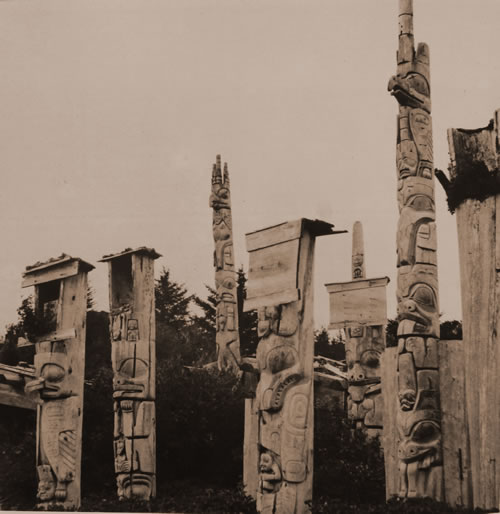
Before Settlers
Evidence has shown that the Haida Indians have continuous inhabited their lands for 6,000 to 8,000 years. Since they have such warm and plentiful land that had a lot of flora and fauna they did not really about not having enough food to survive, because of the this they were able to further develop their artistic talents and enrich their culture. Before the settlers they were very independent. All of their people either belonged to Eagle or Raven, these groups were further divided into clans, and always married someone from a different clan. The Haida was a matrilineal community and each clan had more than 20 lineages and each family would display their clan membership with family crests or with totem poles carved out of a cedar tree and placed outside their houses.
Colonial History
It is believed that the first encounter with settlers was in 1774 with the Spanish explorer Juan Pérez; however, some academics have suggested that Russian explorers may have contacted the Haida as early as 1741. In 1787 British Captain George Dixon initiated trade with the Haida people for otter-pelts which were very valuable, this trade continued until about the 1800’s.
European settlers did not populate the Haida land until about the 1900’s. The Haida populations started to decline due to the violent encounters with the Europeans, and the disease the settlers brought over. Their populations was almost 14,000 before, after contact the population declined to 588 people. The Canadian government forced the children to go to residential schools and forbid them to speak their own languages and practice their own culture. The Haida Nation has claimed Aboriginal titles over all their lands but are unable to reach a formal treaty agreement with the British Colombian Government due to the valuable lands for logging. The government promised the people that if they became like the whites and acted like them and gave up their own ways, that their land would be protected. Like with many tribes the government did not stay true to this promise.
https://www.thecanadianencyclopedia.ca/en/article/haida-native-group
The Haida (HIGH-dah)Indians are original people of the Pacific Northwest Coast, they live on the islands that boarder the coast of southeastern Alaska and northwest British Columbia, and in the Haida Gwaii or the Queen Charlotte Islands. There were about 14,000 native people and 124 villages. Now most of their people speak English but many still speak their own language Xaad kil, which is very complicated and includes new sounds that do not exist in English. They are know for their trade skills and business skills, soldiers, and being seamen.
This is an example post, originally published as part of Blogging University. Enroll in one of our ten programs, and start your blog right.
You’re going to publish a post today. Don’t worry about how your blog looks. Don’t worry if you haven’t given it a name yet, or you’re feeling overwhelmed. Just click the “New Post” button, and tell us why you’re here.
Why do this?
The post can be short or long, a personal intro to your life or a bloggy mission statement, a manifesto for the future or a simple outline of your the types of things you hope to publish.
To help you get started, here are a few questions:
You’re not locked into any of this; one of the wonderful things about blogs is how they constantly evolve as we learn, grow, and interact with one another — but it’s good to know where and why you started, and articulating your goals may just give you a few other post ideas.
Can’t think how to get started? Just write the first thing that pops into your head. Anne Lamott, author of a book on writing we love, says that you need to give yourself permission to write a “crappy first draft”. Anne makes a great point — just start writing, and worry about editing it later.
When you’re ready to publish, give your post three to five tags that describe your blog’s focus — writing, photography, fiction, parenting, food, cars, movies, sports, whatever. These tags will help others who care about your topics find you in the Reader. Make sure one of the tags is “zerotohero,” so other new bloggers can find you, too.

 Alia's Blog